
How Oil and Gas Prices Affect Mineral Rights Value
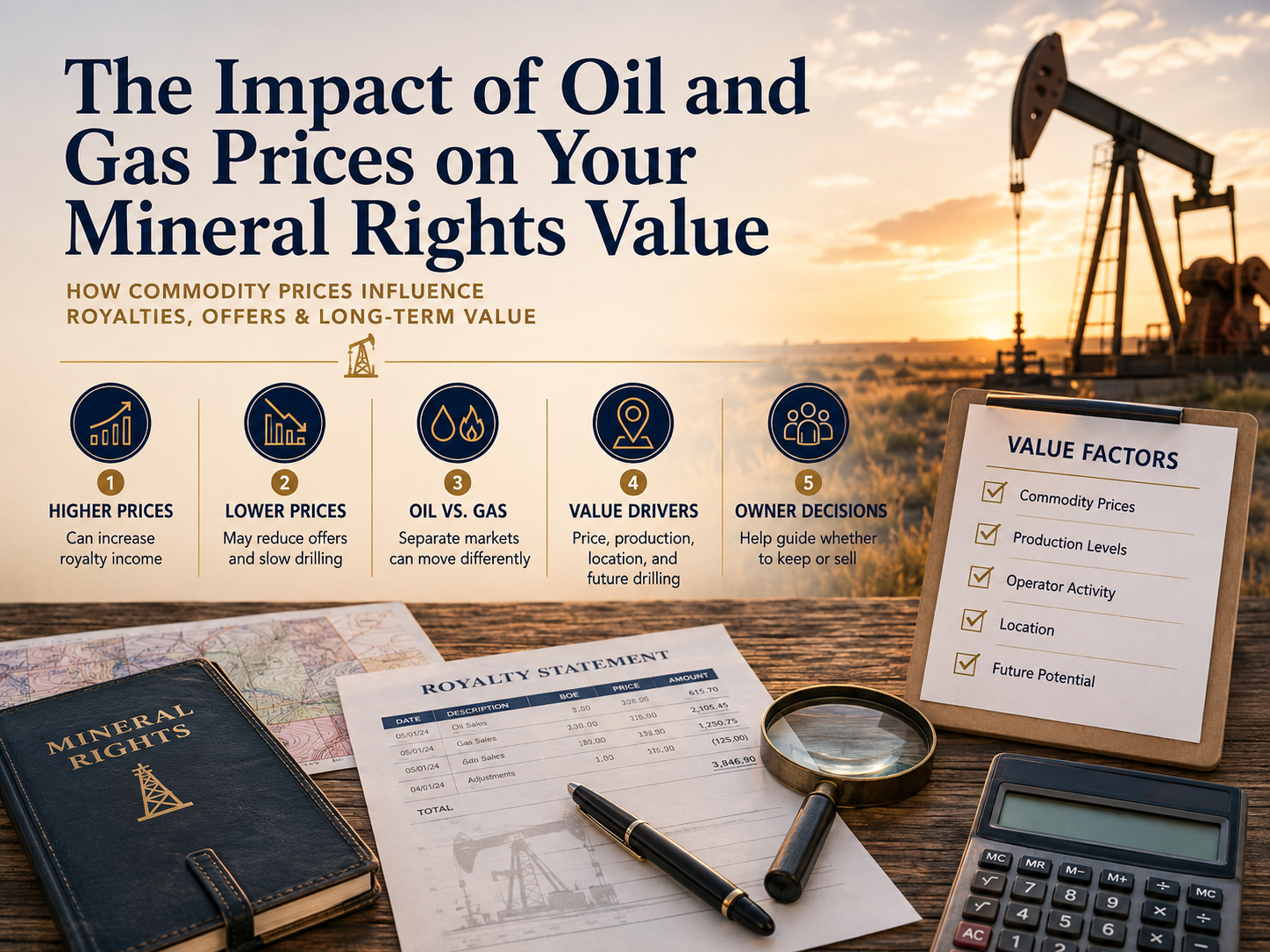
Oil and gas prices can have a major effect on the value of your mineral rights. When prices rise, royalty income may increase, drilling activity may expand, and buyers may become more interested in purchasing mineral interests. When prices fall, royalty checks may shrink, operators may slow development, and market offers may become more conservative.
For mineral and royalty owners, this can make valuation feel confusing. One month, your royalty income may look strong. A few months later, changing commodity prices, production declines, or operator decisions may affect what that interest is worth.
Understanding how oil and gas prices influence mineral rights value can help you make more informed decisions about whether to keep your royalties, sell your mineral rights, or request an offer from a company like Legacy Royalties.
Why Commodity Prices Matter to Mineral Rights Owners
Mineral rights value is closely tied to the future income those rights may produce. Since royalty income depends in part on the price of oil and natural gas, commodity prices play an important role in valuation.
When oil or gas prices are higher, producing wells may generate more revenue. This can increase royalty payments and may make mineral interests more attractive to buyers. Higher prices can also encourage operators to drill new wells, complete existing wells, or expand activity in productive areas.
When prices are lower, the opposite may happen. Operators may delay drilling, reduce activity, or focus only on their most profitable acreage. Royalty income may decline, and buyers may factor that uncertainty into their offers.
Oil Prices vs. Natural Gas Prices
Not all mineral rights are affected the same way. Some interests are tied mostly to oil production, while others are more heavily tied to natural gas. Some wells produce both.
Oil and natural gas are separate markets, and their prices do not always move together. Oil prices may be influenced by global supply and demand, international conflict, transportation costs, production decisions, and refinery needs. Natural gas prices may be affected by weather, storage levels, export demand, pipeline capacity, and regional market conditions.
Because of this, two mineral owners may have very different experiences even if they both receive royalty checks. One owner’s value may be driven mostly by oil prices, while another’s may depend more on natural gas prices.
How Higher Prices Can Increase Mineral Rights Value
Higher oil and gas prices can improve mineral rights value in several ways.
First, higher prices may increase the revenue from producing wells. If production volumes remain steady and prices rise, royalty payments may go up.
Second, higher prices may make future drilling more attractive. Operators are more likely to invest in new wells when they believe production will be profitable. If your mineral rights are located in an active area with development potential, higher prices can make those future opportunities more valuable.
Third, higher prices may increase buyer demand. Companies that purchase mineral and royalty interests may be more active when commodity prices support stronger future cash flow.
However, higher prices do not automatically mean every mineral interest is worth more. Production history, location, lease terms, operator activity, and future development potential still matter.
How Lower Prices Can Affect Mineral Rights Value
Lower oil and gas prices can reduce mineral rights value by lowering current income and increasing uncertainty about future development.
If a producing well is tied to lower commodity prices, royalty payments may decrease even if the well continues to produce. In some cases, wells with marginal economics may be shut in or operated less aggressively.
Lower prices can also cause operators to delay drilling plans. If future wells are less likely to be drilled soon, buyers may place less value on undeveloped acreage or non-producing mineral interests.
This does not mean mineral rights lose all value when prices decline. Long-term buyers still evaluate location, geology, existing production, nearby drilling, and future potential. But lower prices often create a more cautious valuation environment.
Production Decline Also Affects Value
Commodity prices are important, but they are only one part of the picture. Production decline can also have a major effect on mineral rights value.
Most oil and gas wells produce the most in their early stages and decline over time. Even when commodity prices are strong, royalty income may fall if production volumes decline. On the other hand, a new well or increased development nearby may improve future income potential.
That is why mineral rights valuation is not based only on a recent royalty check. A proper review should consider both price and production trends.
Why Royalty Checks Do Not Tell the Whole Story
Many mineral owners use their royalty checks as the main way to think about value. While royalty income is important, it does not show the full picture.
A royalty check reflects what happened during a specific payment period. It may not account for future wells, production declines, changes in commodity prices, lease terms, title issues, or operator plans.
For example, a strong royalty check may be temporary if a well is early in its production life and expected to decline. A smaller royalty check may not fully reflect future drilling potential if nearby activity is increasing.
This is why a mineral rights offer may be higher or lower than an owner expects.
For a deeper look at the factors that influence market value, read our guide to understanding mineral rights valuation in Texas.
When Selling Mineral Rights May Make Sense
Some mineral owners choose to keep their rights and continue receiving royalty income. Others prefer to sell all or part of their interest in exchange for a lump-sum payment.
Selling mineral rights may make sense if you want to:
- Convert unpredictable royalty income into cash
- Reduce exposure to oil and gas price swings
- Simplify estate planning or inheritance issues
- Avoid managing small or fractional interests
- Use the funds for retirement, debt, investment, or family needs
- Take advantage of buyer interest during favorable market conditions
Selling is a personal decision. The right choice depends on your financial needs, risk tolerance, family situation, and long-term goals.
How Legacy Royalties Helps Mineral and Royalty Owners
Legacy Royalties works with mineral and royalty owners who are considering selling oil and gas interests. Our team reviews mineral rights, royalty income, location, production activity, and market conditions to provide purchase offers based on the specific interest.
We help owners better understand their options so they can make informed decisions about whether selling makes sense.
Legacy Royalties can assist with:
- Reviewing producing and non-producing mineral interests
- Evaluating royalty income and production history
- Considering how oil and gas prices may affect value
- Providing purchase offers for mineral and royalty interests
- Helping owners compare keeping royalties vs. selling
- Supporting families, heirs, and advisors during ownership decisions
Mineral owners can also review common ownership mistakes before making decisions about whether to hold, lease, or sell.
FAQs About Oil and Gas Prices and Mineral Rights Value
Do mineral rights become more valuable when oil prices go up?
They can. Higher oil prices may increase royalty income and buyer interest, especially for producing mineral rights or interests located in active drilling areas. However, value also depends on production, location, lease terms, and future development potential.
Do natural gas prices affect mineral rights value?
Yes. If your mineral rights are tied to natural gas production, changes in natural gas prices can affect royalty income and market value. Natural gas prices may be influenced by weather, storage levels, export demand, and regional pipeline access.
Why did my royalty check go down if prices are still strong?
Your royalty check may decline because of lower production volumes, well decline, deductions, downtime, changes in product mix, or timing differences in payment. Commodity prices are important, but they are not the only factor that affects royalty income.
Is now a good time to sell mineral rights?
The right time to sell depends on your goals, the current value of your interest, market conditions, and your need for liquidity. Some owners sell when prices are strong, while others sell to simplify an estate, reduce risk, or convert future income into a lump-sum payment.
How can I find out what my mineral rights are worth?
The best way to understand potential value is to have your mineral or royalty interest reviewed. Legacy Royalties can evaluate available information, including royalty income, location, production history, and market conditions, and provide an offer for your consideration.
Talk With Legacy Royalties About Your Mineral Rights
Oil and gas prices can change quickly, and those changes may affect both royalty income and mineral rights value. Whether you are receiving regular royalty checks, managing inherited interests, or considering a sale, it is important to understand how market conditions may influence your options.
Legacy Royalties helps mineral and royalty owners evaluate their interests and consider whether selling may be the right choice.
Contact Legacy Royalties to request more information or discuss your mineral rights.
Disclaimer: This article is for general informational purposes only and should not be considered legal, tax, financial, or investment advice. Mineral rights valuation and sale decisions should be reviewed with qualified legal, tax, and financial professionals.
