
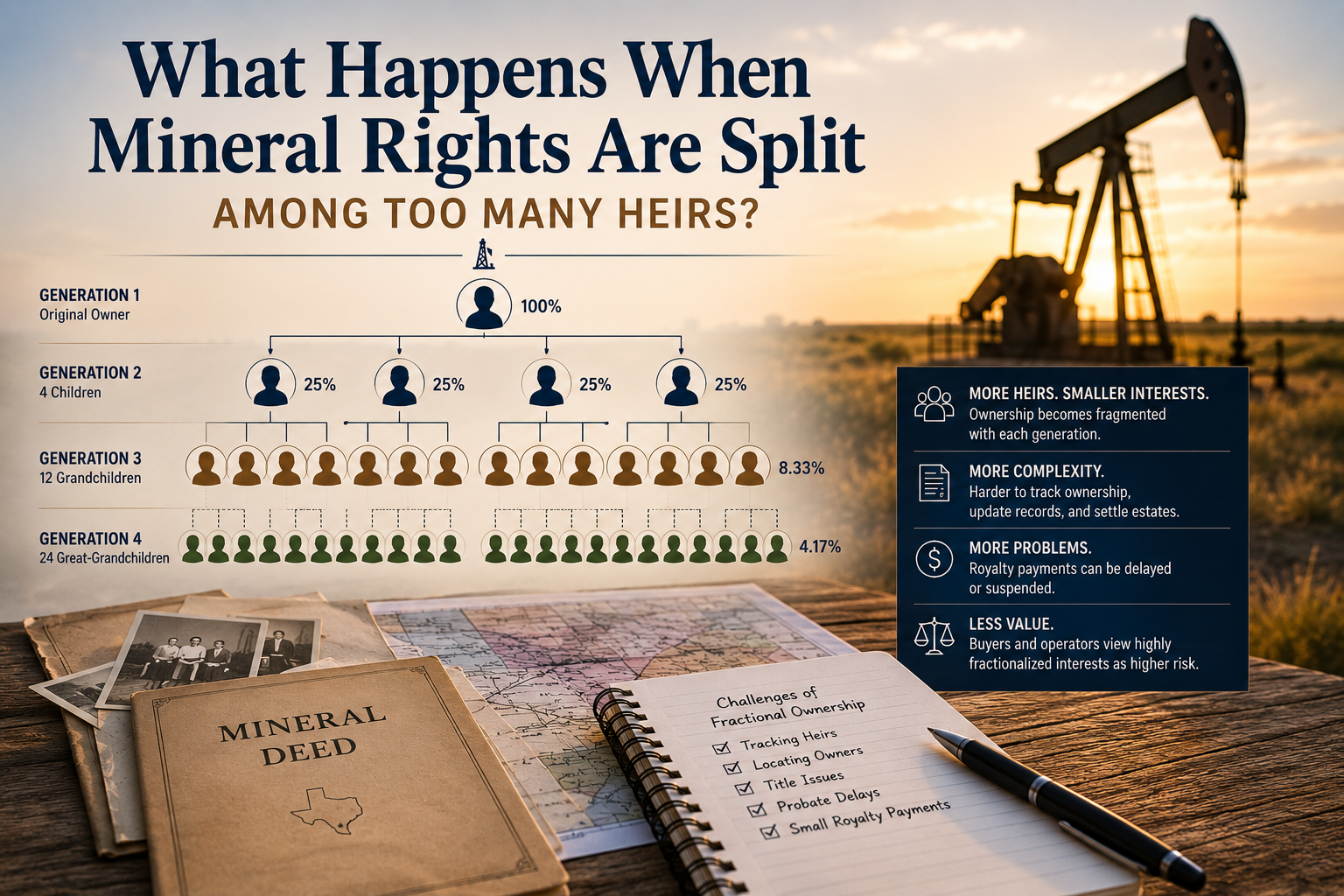
Mineral rights are often passed from one generation to the next with the best intentions. Over time, however, those interests can become divided among children, grandchildren, and future heirs until ownership is spread across dozens—or even hundreds—of individuals.
This process, known as fractionalization, is one of the most common challenges facing mineral-owning families today. While each heir may still own a legal interest, increasingly fragmented ownership can create administrative, financial, and estate planning complications.
At Legacy Royalties, we frequently help families understand how fractionalized mineral ownership develops and what options may exist to simplify management.
What Is Mineral Rights Fractionalization?
Fractionalization occurs when mineral interests are inherited by multiple heirs over several generations.
For example:
- A parent owns 100% of a mineral interest.
- Four children each inherit 25%.
- Those four children later pass their interests to multiple heirs.
- Ownership continues to divide with each generation.
After several decades, a single mineral property may be owned by dozens of family members, each holding a very small percentage.
Why Fractional Ownership Can Become a Problem
While ownership itself remains valid, management often becomes more difficult as the number of owners grows.
Common challenges include:
- Tracking current ownership records
- Locating heirs
- Updating title documents
- Coordinating decisions among family members
- Managing probate across multiple generations
The more fragmented an ownership structure becomes, the more complicated it can be to maintain.
How Fractionalization Impacts Royalty Income
As ownership percentages shrink, royalty payments are divided among more people.
| Ownership Generation | Ownership Percentage |
| Original owner | 100% |
| Four children | 25% each |
| Twelve grandchildren | Approximately 8.3% each |
| Twenty-four great-grandchildren | Approximately 4.1% each |
While production may continue, individual royalty checks often become much smaller over time.
In some cases, administrative costs and ownership complexities begin to outweigh the financial benefits of maintaining highly divided interests.
Title and Probate Issues Often Increase
Fractionalized mineral ownership frequently creates title complications.
Buyers and operators may encounter:
- Missing probate records
- Unknown heirs
- Unrecorded ownership transfers
- Conflicting title documents
- Suspended royalty payments
When ownership cannot be clearly established, royalty funds may be placed in suspense until documentation is resolved.
Why Buyers Pay Attention to Fractionalization
When evaluating mineral interests, buyers often consider ownership structure alongside production and location.
Factors that may affect value include:
- Number of owners involved
- Clarity of title records
- Ease of transferring ownership
- Potential future probate issues
- Administrative complexity
Simple ownership structures are often easier to evaluate and transfer than heavily divided interests.
Options for Families Facing Fractionalized Ownership
Every situation is different, but families often explore several strategies to reduce future complications.
Potential approaches include:
- Updating ownership records regularly
- Completing probate promptly
- Using trusts for succession planning
- Consolidating interests where appropriate
- Reviewing long-term estate planning goals
Addressing these issues early may help prevent larger problems later.
Frequently Asked Questions
Is it common for mineral rights to be split among many heirs?
Yes. Fractionalization is extremely common among mineral-owning families, particularly when interests have been passed down for multiple generations.
Can royalty payments stop because of ownership issues?
Yes. Operators may suspend payments if ownership documentation is incomplete or unclear.
Does fractionalization reduce mineral value?
Not necessarily, but it can create administrative and title complications that buyers may factor into their evaluation.
Can mineral interests be consolidated again?
In some situations, yes. Families may choose ownership structures that centralize management and reduce future fragmentation.
Why should mineral rights be included in estate planning?
Without proper planning, mineral interests often become increasingly divided, creating ownership and management challenges for future generations.
Planning Ahead Can Preserve Value
Mineral rights can remain valuable assets for generations, but ownership structures matter. As interests become divided among more heirs, title issues, administrative burdens, and royalty management challenges often increase.
By understanding how fractionalization occurs and planning proactively, families can help preserve both the value and manageability of their mineral interests.
At Legacy Royalties, we help mineral owners evaluate ownership structures, identify potential complications, and make informed decisions about the future of their mineral assets.
